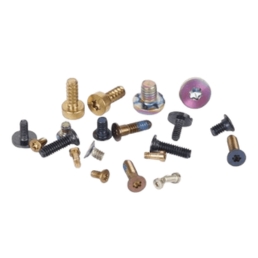
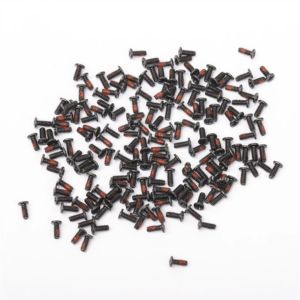
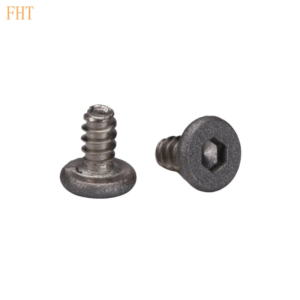
Precision screws are the unsung heroes of modern engineering, holding together everything from smartphones to airplanes. Their performance hinges on a delicate balance of strength, durability, and precision. One critical process that shapes these properties is heat treatment—a controlled method of heating and cooling metal to alter its internal structure. For manufacturers and engineers, understanding how heat treatment impacts precision screws is essential to optimizing their functionality. This article explores the science behind heat treatment and its far-reaching effects on screw performance.
Table of Contents
1. The Basics of Heat Treatment:
Heat treatment involves three primary stages: heating, holding (soaking), and cooling. The process begins by heating the screw to a specific temperature, often just below its melting point, to allow its internal crystals to rearrange. During the soaking phase, the metal remains at this temperature to ensure uniformity. Finally, rapid cooling (quenching) or gradual cooling (annealing) locks in the desired structure. Each step is meticulously controlled to achieve precise outcomes, such as increased hardness or improved ductility.
The choice of cooling method depends on the metal’s composition and the intended application. For example, quenching in oil or water might harden a screw, while annealing could soften it for easier machining. Without heat treatment, screws would lack the tailored properties needed to withstand extreme conditions, making the process indispensable in industries like aerospace and automotive manufacturing.
2. Enhancing Hardness and Wear Resistance:
One of the most significant benefits of heat treatment is its ability to boost a screw’s hardness. Hardness refers to a material’s resistance to deformation, scratching, or indentation. By heating the screw to a critical temperature and then rapidly cooling it, manufacturers can transform its internal structure into a harder phase called martensite. This process, known as quenching, is particularly effective for steel screws, which are commonly used in high-stress environments.
However, increased hardness often comes with a trade-off: brittleness. To mitigate this, screws undergo tempering—a secondary heat treatment that reduces brittleness while retaining hardness. Tempering involves reheating the screw to a lower temperature and holding it there before cooling. The result is a screw that resists wear and tear without cracking under pressure, making it ideal for applications like automotive engines or industrial machinery.
3. Improving Tensile Strength and Durability:
Tensile strength measures a screw’s ability to withstand pulling forces without breaking. Heat treatment can significantly enhance this property by refining the metal’s grain structure. During heating, the metal’s grains expand, and during cooling, they contract. Controlled cooling rates encourage the formation of smaller, more uniform grains, which distribute stress more evenly across the screw.
This microstructural refinement is crucial for screws subjected to cyclic loading, such as those used in bridges or aircraft. Over time, repeated stress can cause microscopic cracks to form, leading to fatigue failure. Heat-treated screws with optimized grain structures are more resistant to crack propagation, extending their lifespan and ensuring reliability in critical applications.
4. Reducing Internal Stresses for Stability:
Manufacturing processes like cold heading or threading can introduce internal stresses into a screw. These stresses, if left unaddressed, may cause the screw to warp or fail prematurely. Heat treatment alleviates these stresses through a process called stress relieving. By heating the screw to a moderate temperature and holding it there, the metal’s atoms rearrange into a more stable configuration, reducing residual tension.
Stress relieving is particularly important for precision screws used in optical instruments or medical devices, where even slight deformations can compromise functionality. A stress-relieved screw maintains its dimensional accuracy over time, ensuring consistent performance in sensitive environments.
5. Optimizing Machinability and Dimensional Accuracy:
While heat treatment is often associated with hardening, it can also improve a screw’s machinability—the ease with which it can be cut, shaped, or threaded. Annealing, a heat treatment process that involves slow cooling, softens the metal by allowing its grains to grow larger and more uniform. Softer metal is easier to machine, reducing tool wear and minimizing errors during production.
Additionally, heat treatment can enhance dimensional accuracy by minimizing distortion during manufacturing. For example, screws that undergo case hardening—a process that hardens only the outer layer while keeping the core soft—are less likely to warp during threading or finishing. This precision is vital in industries like electronics, where screws must fit snugly into tiny components without damaging them.
6. Balancing Corrosion Resistance and Performance:
Corrosion resistance is another critical factor in screw performance, especially in outdoor or marine environments. While heat treatment primarily focuses on mechanical properties, it can indirectly influence corrosion resistance by altering the metal’s surface chemistry. For instance, quenching and tempering can create a protective oxide layer on the screw’s surface, reducing its vulnerability to rust.
However, some heat treatments, like carburizing (which adds carbon to the surface), may make the metal more prone to corrosion if not properly coated. Manufacturers often combine heat treatment with surface treatments like plating or coating to strike a balance between strength and corrosion resistance. This dual approach ensures that screws remain durable even in harsh conditions.
7. Conclusion: The Art and Science of Heat Treatment:
Heat treatment is both an art and a science, requiring precise control over temperature, time, and cooling rates to achieve the desired properties. For precision screws, this process is the key to unlocking superior hardness, tensile strength, and durability while maintaining dimensional accuracy and corrosion resistance. By tailoring heat treatment techniques to specific applications, manufacturers can produce screws that meet the exacting demands of modern engineering.
From smartphones to skyscrapers, the performance of precision screws shapes the reliability and safety of countless technologies. Understanding the role of heat treatment in this process empowers engineers and manufacturers to push the boundaries of innovation, ensuring that these tiny components continue to hold the world together, one screw at a time.